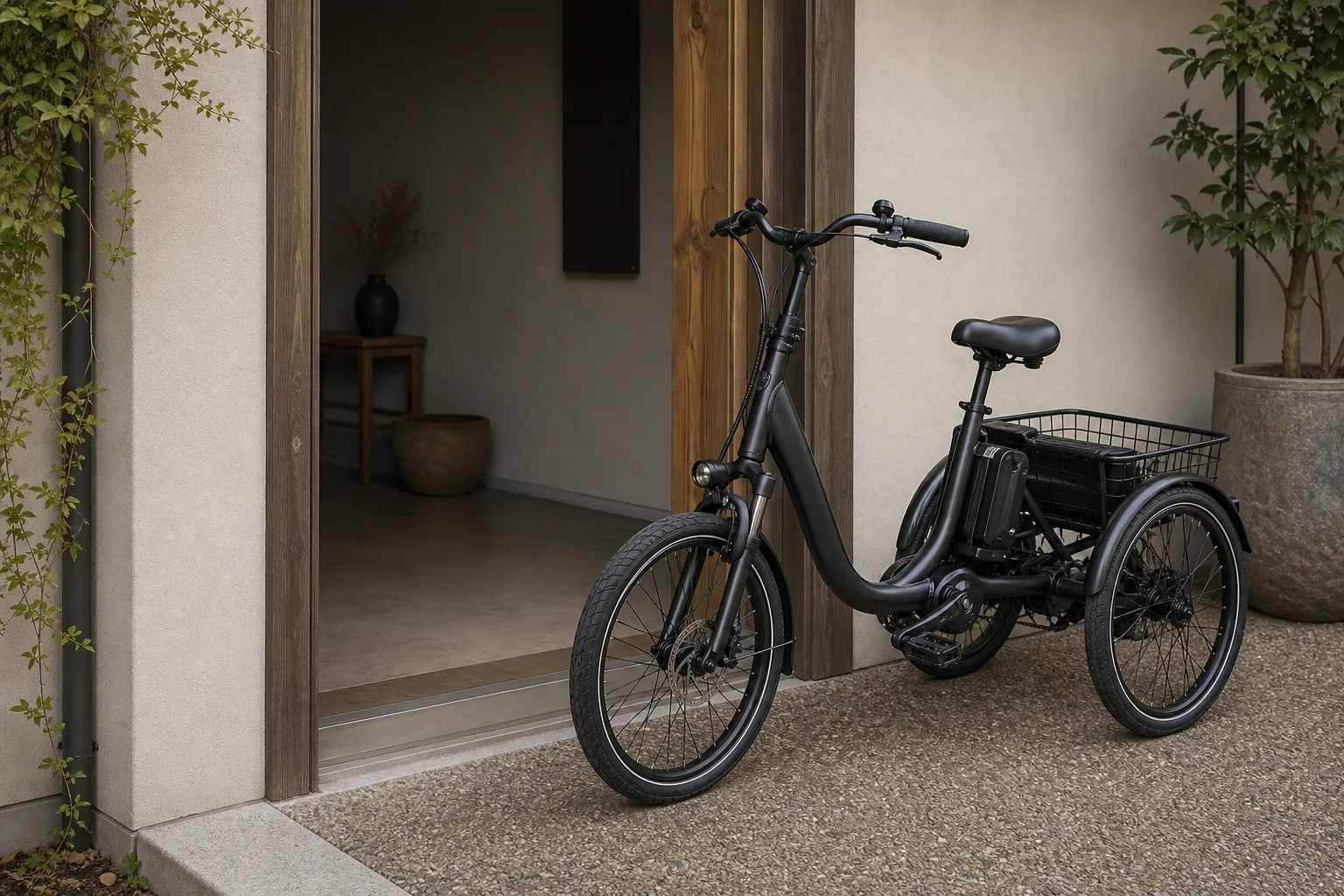
A trike that fits the rider and not the building gets ridden twice. The specification sheet answers the easy questions, seat height and gear range and battery capacity, while the questions that decide whether the machine leaves the garage on a Tuesday morning sit outside the sheet entirely: the clear opening of the side door, the weight your shoulders can lift to hip height, the distance from the parking spot to the nearest grounded receptacle, and whether any shop within driving range will put a 70-pound three-wheeler on a repair stand. Each of those is measurable in an afternoon with a tape measure and three phone calls.
1. Measure the narrowest point on the route, not the door
Adult trikes commonly run somewhere between 28 and 34 inches across the rear axle, and a standard interior door leaf of 30 inches gives a clear opening closer to 28 once the stops and the hinge swing are counted. That arithmetic is why so many trikes live outdoors. Walk the actual route with a tape: the gate, the garage side door, the turn at the bottom of a hallway where the width matters less than the swept path of a turning axle, the shed threshold. Note the tightest number, then subtract an inch for knuckles.
2. Check the bike path, the bollard, and the curb cut
Shared paths built to accommodate wheelchairs will take almost any trike, but the hardware placed on them to exclude motorbikes will not always oblige. Bollard pairs, staggered gates, and the pinch point where a path meets a bridge deck are the usual offenders, and a 34-inch axle finds them all. Ride or walk the commute before buying if the machine is meant for a specific route. Curb cuts matter separately, since a trike cannot be hopped up a lip; a two-inch upstand taken at an angle will stop one wheel and steer the frame sideways.
3. Weigh what you will actually lift, and when
Listings quote a total weight, often 55 to 75 pounds for a non-assisted folding trike and 70 to 95 pounds with a motor and battery. Total weight is the wrong figure for a car rack. What you lift is the heaviest single handful, and that depends on where the frame balances and whether the battery comes out first, which typically removes 6 to 10 pounds from the equation. Hitch platform racks rated for trikes exist, and so do folding models that go into a trunk in two pieces, but check the rack's per-tray limit and its tray width against your axle before ordering.
4. Read the transit rules for the vehicle you ride
Front-mounted bus racks are built for two-wheelers and generally will not accept a trike, and rail systems vary by line, by car type, and by hour. Some agencies treat a folded trike as luggage, which is the useful category, while others treat any cycle as a cycle and apply peak-hour bans. Call the agency rather than reading the website summary, and ask specifically about a folded three-wheeler carried by hand. The answer you get will decide whether folding is worth the extra cost, the extra hinges, and the maintenance those hinges bring.
5. Solve the charging distance before you need it
Batteries on low-speed electric trikes are almost always removable, which is the feature that makes an apartment or a detached garage workable: the pack comes indoors and charges on a bench near an outlet. Confirm the removal mechanism and the pack weight before purchase, and confirm the charger's own footprint, since some units run warm and want clearance. Where the pack does not come off, the fix is an outdoor-rated receptacle within cord reach, installed by a licensed electrician; the Consumer Product Safety Commission is responsible for safety standards covering these products, and extension cords run under doors are not what the manuals contemplate.
6. Find the mechanic first, then buy
Shops turn down trikes for reasons of physics, not attitude. A conventional repair stand clamps a seatpost and lets the wheels hang; a trike will not hang, and a 70-pound frame needs floor space, a jack or a low platform, and a technician willing to work kneeling. Call three shops and ask whether they service adult trikes, whether they have worked on internally geared rear hubs or differentials, and whether they will handle a mid-drive or hub motor. One yes within a reasonable drive is enough, and that yes is worth paying more for the trike it covers.
Take the tape measure to the house before the showroom, write down four numbers, and let them narrow the list. Trikes that clear all four get used, and the ones that get used are the ones that pay for themselves.